
Led by Trent, which hit its lifetime-high recently, apparel retailers have gained between 10 per cent and 36 per cent over the past three weeks. Given the network of physical stores, these stocks shall be major beneficiaries of the unlock theme, with most states doing away with Covid restrictions. Amid improving footfall, analysts expect the sector to post double-digit growth in FY23.

The auto major had posted a profit of Rs 3,945.47 crore (Rs 39.45 billion) in the same period a year earlier.

The BSE Midcap and the BSE Smallcap indices pared all intraday gains to end 0.3% and 0.5% lower

Housing finance major HDFC on Monday reported a 16 per cent growth in standalone net profit to Rs 3,700 crore for the January-March quarter, helped by record loan sales on the back of benign interest rates and the resultant fall in cost of funds along with the near-total repayments that culled provisions and credit costs. For the full year, the company, which is working on a reverse merger with its banking subsidiary, has booked a net profit of Rs 13,742 crore, up from Rs 12,027 crore in FY21, vice-chairman and chief executive Keki Mistry said on Monday in an earnings call with analysts. On a consolidated basis, net profit for the quarter surged 21.6 per cent to Rs 6,892 crore on-year and for the full year it jumped 21 per cent to Rs 22,595 crore, Mistry said and guided towards better days.

India Inc resorted to salary cuts to protect their profits in the June quarter, as revenues came under pressure due to the second pandemic wave that affected nearly the entire country, a report said on Wednesday. The "weak" wage growth will prove to be a drag on the overall economic recovery in the medium term as it will affect household consumption, the report by India Ratings and Research said. An environment of pandemic-led uncertainty and elevated inflation could impact the level of spending and hence the overall demand, it said.

With decline in number of fresh COVID-19 cases and easing of restrictions, the country's gross domestic product (GDP) will grow at 8.5 per cent in FY2021-22, according to credit rating agency Icra Ratings. It expects the gross value added (GVA) at basic prices (at constant 2011-12 prices) to grow at 7.3 per cent in FY2022. "The impact of the second wave of COVID-19 and the ensuing state-wise restrictions was seen across a variety of high frequency indicators in April-May 2021.

Limited visibility around tariff hike and lack of clarity on new funding could make Vodafone Idea "more dependent" on any form of government relief for improvement of its fundamentals, BofA Securities has said in its latest report. The top brass of cash-strapped telco Vodafone Idea had last week said 'floor price' remains the "best and most preferred" fix for industry's woes arising from tariff-related issues. The company, whose fundraising plans have been significantly delayed, had further said it is in active talks with potential investors, and emphasised that there is no reason to start working on an alternate 'Plan B'.

Mark Zuckerberg, founder and CEO of Meta, summed it up well as he explained the reason for the company sacking 13 per cent of its employees. He said no one predicted that the boom for digital services during the Covid pandemic would die out. "Many people predicted this would be a permanent acceleration that would continue even after the pandemic ended.

Bajaj Finance was the top laggard in the Sensex pack, plunging around 6 per cent, followed by IndusInd Bank, SBI, M&M, Axis Bank, Bajaj Auto and ICICI Bank. NSE Nifty sank 229.55 points to 14,637.80.

Axis Bank and ICICI Bank consumed 37-59 per cent of their operating profit for COVID-19 provisioning, while the figure is 24 per cent in case of Kotak Mahindra Bank and 10-12 per cent for IndusInd Bank and HDFC Bank.
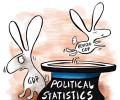
There has been criticism of the official statistics ever since MoSPI came out with new methodology to estimate the GDP on the base year of 2011-12 compared to earlier 2004-05.

The third-quarter financials didn't excite market watchers. But equity investors can still make money if they invest in the right stocks.

IndusInd Bank was the top gainer in the Sensex pack, rallying over 7 per cent, followed by SBI, ICICI Bank, HDFC twins, Axis Bank, Bajaj Finserv and UltraTech Cement. NSE Nifty soared 245.35 points to 14,923.15.

10 stocks which are most popular with brokerages right now and are expected to deliver maximum upside over the next 12 months.
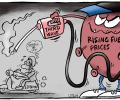
A surge in international oil prices may translate into an increase in the retail selling price of petrol and diesel in India as oil companies face extreme margin squeeze, sources said. Petrol and diesel prices have remained unchanged for 12 days but now the international rate surge is exerting pressure. Current prices of petrol and diesel in the international market are higher by around $4-6 per barrel as compared to average prices during August. However, no increase in retail prices has been affected by oil companies so far, sources said.

Corporate earnings grew in double digits during the April-June 2022 (Q1FY23) quarter but the momentum waned. Overall corporate earnings in the quarter were down sharply from their highs in FY22. The combined net profit of 2,981 listed companies across sectors in the Business Standard sample was up 22.4 per cent YoY to Rs 2.24 trillion in the June quarter, driven by a big jump in the earnings of banks, non-banking lenders, oil & producers, and FMCG companies. Also, earnings in the corresponding quarter a year ago were affected because of the second wave of the Covid pandemic, even though the numbers were a lot better than Q1FY21 when there was a nationwide lockdown.

Members of the Monetary Policy Committee (MPC) felt that though the Indian economy was resilient in the third wave, it, however, lost some momentum and with inflation likely to soften, there is room to continue with the accommodative stance and support revival, the minutes of the MPC meeting released on Thursday revealed. The six-member MPC voted to keep the policy rate unchanged and continued with the accommodative stance at its meeting on February 10. However, external member Jayanth Verma voted against the stance because he felt a switch to neutral was long overdue and the current stance has become counterproductive and deflects focus away from addressing recessionary trends that date back to at least 2019.

Tata Sons, India's biggest promoter in the private sector, is expected to earn a record Rs 27,797 crore via equity dividend and proceeds through share buyback from its listed group companies for the financial year 2021-22. This amount is up 17.6 per cent from Rs 23,663 crore that it pocketed in FY21. Nearly two-thirds of these proceeds will show up in Tata Sons' financial results for FY22, thanks to the quarterly interim dividend by its cash cow Tata Consultancy Services (TCS).

Sensex eneded lower on poor perfromance by financials and IT stocks.

The cumulative loss of 20 state-run lenders stood at Rs 14,000 crore during Q4

The Reserve Bank's growth projection for next financial year is lower than 8-8.5 per cent projected by the finance ministry in the recent Economic Survey which was tabled in Parliament on January 31. Unveiling the bi-monthly policy, RBI governor Shaktikanta Das said, "Recovery in domestic economic activity is yet to be broad-based, as private consumption and contact-intensive services remain below pre-pandemic levels."

The unprecedented rise in Covid-19 infections in the country, which many are terming as the second wave, has also resulted in a rise in Covid-related claims for general and health insurance companies as hospitalisations have gone up. The insurers have received more than a million Covid-related claims as of April, 2021. According to the data compiled by General Insurance Council, the reported claims total 1.014 million, amounting to more than Rs 14,800 crore.

Not surprisingly, equity investors are bidding-up stock prices across sectors and the broader market is now more valuable than pre-Covid levels.
The group began to outperform the broader market only with the onset of the pandemic in March 2020 while earlier it was largely keeping pace with the Sensex. The group's market cap is up 164.4 per cent since the end of March 2020 against a 105 per cent rally in the Sensex.

The American influential IT and telecom industry sought intervention of the Obama Administration against what they alleged are "discriminatory" Indian policies, which they claimed has resulted in several hundred millions of dollars of losses in the last quarter.

The change in ownership is expected to give a fresh lease of life to the company that has often been dragged by financial stress in its close to three-decade journey under the Khaitans, reports Ishita Ayan Dutt.

Making a call on gold price trends through 2013 will be a toss-up.
Total network minutes rise 5% q-o-q but revenue per minute down 1.9%
In the broader market, the S&P BSE Midcap added over 1% to finish at record closing high

Starting with the third quarter of financial year 2020-21 (Q3FY21), we have seen "unlock" trades at various times. Whenever lockdowns have been eased, traders have taken long positions in consumer-facing businesses. Let's look at the logic. Since March 2020, sectors like retail, personal vehicles, hospitality, aviation, fast-moving consumer goods (FMCG), multiplexes, etc., have been under severe pressure. As a result, there's been a low base effect. Every company in these spaces has suffered top line contraction. Many suffered losses, especially in the first half of FY21.

RIL, however, remains miles ahead of TCS in other financial parameters such as total revenue, operating profit, net worth, assets, and market capitalisation.
The broader markets outperformed the benchmark indices- BSE Midcap and Smallcap indices gained 0.4% each

Yes Bank CEO said the private lender is disposing some of the properties in many other cases as well. He, however, declined to elaborate on borrowers against whom such action was underway.
LML set off the blocks, rising 3.66% to Rs 29.75, what with a net profit growth of 41.44% for Q4.

Sectorally, telecom, realty, auto and banks were among the top losers, shedding as much as 2.22 per cent.

Jio's revenue increase was phenomenal in many circles: In Haryana, the RMS gain was 13 percentage points; in Bihar, 20 percentage points; in Odisha, 15 percentage points; and in Assam, 11 percentage points. However, incumbent telcos said this increase was only in three quarters, and it happened because of an order by the Telecom Regulatory Authority of India, which tweaked the definition of significant market player (SMP) for predatory pricing.

Risk aversion is currently a dominant depressant to economic recovery, points out Shankar Acharya, former chief economic advisor to the Government of India.

The government propagandists should refrain from premature celebrations and misplaced euphoria: Congress.

The COVID-19 pandemic has not only affected outpatient services, but also led to deferment of elective surgeries, and resulted in the loss of medical tourism, all of which would hit the FY21 financials.

Investors accumulated quality stocks at valuable and attractive levels.
